
29 July 2026
Miyuki seed beads: the Japanese tradition behind every thread
Born in Hiroshima in 1949, Miyuki seed beads permanently changed the way beaded jewellery is conceived and made. Discover the history, the production philosophy, and why our atelier works exclusively with this material
Every BBLux jewel begins with a bead. Not figuratively: literally, the first gesture of every piece is threading a single bead onto a thread. And that bead, almost certainly, is a Miyuki.
For anyone who has never worked closely with beads, the name Miyuki might sound like a technical detail — a trade reference, like the name of a fabric or a supplier. In reality it is much more: it is the name of a production philosophy, an approach to material that has deep roots in Japanese craft culture and that has permanently changed the way beaded jewellery is conceived and made around the world.
Hiroshima, 1949: a story of precision
Miyuki Shoji Co. was founded in Hiroshima in 1949, in a Japan painstakingly rebuilding itself after the war. From the beginning, the company specialised in the production of small glass beads — what in the English-speaking world are called seed beads, for their tiny dimensions.
What distinguished Miyuki from its competitors from the earliest years was not only the quality of the glass, but dimensional precision. In a sector where beads had traditionally been produced with significant variations in shape and size — variations that artisans learned to manage, compensate for, conceal — Miyuki introduced calibration standards that made each bead almost identical to the next. Same hole aperture, same weight, same external form.
This precision is not an aesthetic detail. It is a technical revolution. It allows the creation of complex patterns with a regularity that was previously impossible, the accurate calculation of materials needed for a project, the faithful replication of a design. It opens, in essence, the door to a new category of jewel: one in which the bead is not merely a decorative element, but a pixel within a larger image.
The Miyuki philosophy: quality as daily practice
There is a Japanese concept that applies perfectly to the way Miyuki thinks about production: monozukuri. Literally it means "making things", but the word carries a depth that translation cannot fully render: it indicates total dedication to the act of creating, the artisan's pride in producing something excellent, the responsibility toward whoever will use the final product.
In Miyuki's case, monozukuri translates into a quality control that has no equal in the sector. Beads are produced in calibrated batches, dimensionally checked with precision instruments, selected for uniformity of colour and finish. The coatings — from matte to metallic, from AB (aurora borealis) to Ceylon — are applied through processes that guarantee durability over time, resistance to wear and to light.
For an artisan working with Miyuki beads, this quality translates into something very concrete: fewer frustrations, fewer discards, fewer corrections. And above all: the freedom to focus entirely on the creative project, knowing that the material will not disappoint.
From the Hiroshima factory to the BBLux atelier
Every bead we use at BBLux makes a considerable journey before becoming part of a jewel. Produced in Hiroshima, distributed through a global network of specialist suppliers, selected by us for colour, finish and batch, it arrives at our Kent atelier already carrying a production history decades long.
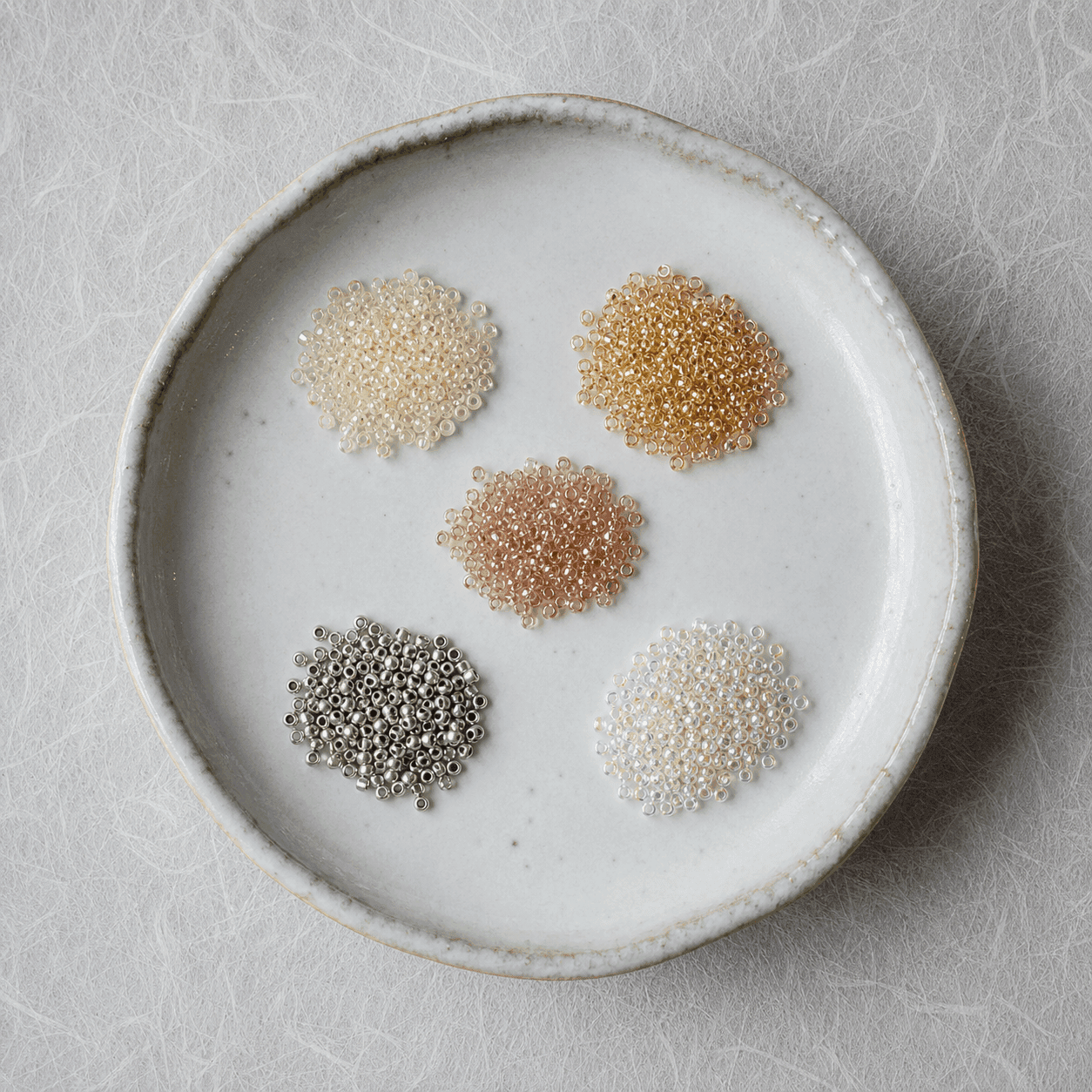
The choice of colours is one of the aspects we take most seriously. The Miyuki palette runs to thousands of variants — not only different colours, but different finishes on the same tone: matte, glossy, translucent, metallic, satin, silver-lined, gold-lined. Each combination creates a different luminous effect, and each luminous effect says something different to the jewel we are building.
When we work on a bespoke piece — commissioned, starting from the preferences of whoever will receive it — the choice of beads is one of the most delicate steps in the process. It is not simply a matter of finding a colour that appeals: it is a matter of finding a quality of light that resonates with the person for whom the jewel is intended.
Why material quality changes the final result
There is a question we are often asked by those approaching the world of beads for the first time: why Miyuki? Less expensive beads exist, produced in other countries, that look visually similar. Why choose a more costly material?
The answer has two parts. The first is technical: lower-quality beads have dimensional variations that accumulate over the course of weaving, creating visible distortions in the pattern, irregular tension in the thread, fragility over time. A bracelet made with calibrated beads and one made with uncalibrated beads may look similar at the moment of creation, but the difference becomes evident after weeks, months, years of wear.
The second part is harder to quantify, but no less real: quality material is felt. Not only by sight — also by touch, by weight, by the way a jewel falls on the wrist or slides between the fingers. There is a density, a consistency, a physical presence in well-made pieces that mediocre pieces do not have.
The bead as a unit of time
There is one final aspect of Miyuki beads worth naming, and it concerns time. An average bracelet made in Miyuki seed beads requires between three and six hours of work, depending on the complexity of the pattern. A bag can require twenty, thirty, even fifty hours.
Every hour of work corresponds to thousands of beads inserted one by one. Every bead is a micro-decision: the direction of the thread, the tension, the sequence. In the end, what you hold in your hands is not only a jewel: it is time. Time transformed into form, into colour, into light.
This is the deepest reason we choose Miyuki: because they deserve the time we give them. And because the jewel that results deserves to be worn for a long time, with care, by whoever receives it.